


Growing up in Malaysia, I always wondered why it was so hot all the time. The only relief came when it rained, those few fleeting moments when the air cooled and the world felt less intense.
As a kid, I was captivated by snowy scenes in Western movies like Home Alone. The snow looked magical, soft, white, and cold. I used to sit there imagining what it would feel like to touch it. I even wished that one day it would snow in Malaysia too. (Although now, knowing a little bit about the physics behind climate, that might not be such a good thing…)
It wasn’t until I was a bit older that I learned in school why our climate is the way it is. I was told, quite simply, that Malaysia is near the equator.
At the time, I remember thinking, what makes the equator so special? Why does being located at the equator change our weather so much? What’s different about it? Thinking back, I realize I didn’t dig deep enough to find the answers to those questions. I experienced this weather every day, but I never really stopped to ask why it was that way. I just accepted it as natural, “it is what it is”.
But those kinds of questions, simple as they may seem, are often the first steps toward understanding our world. They lead us to ask even bigger questions.
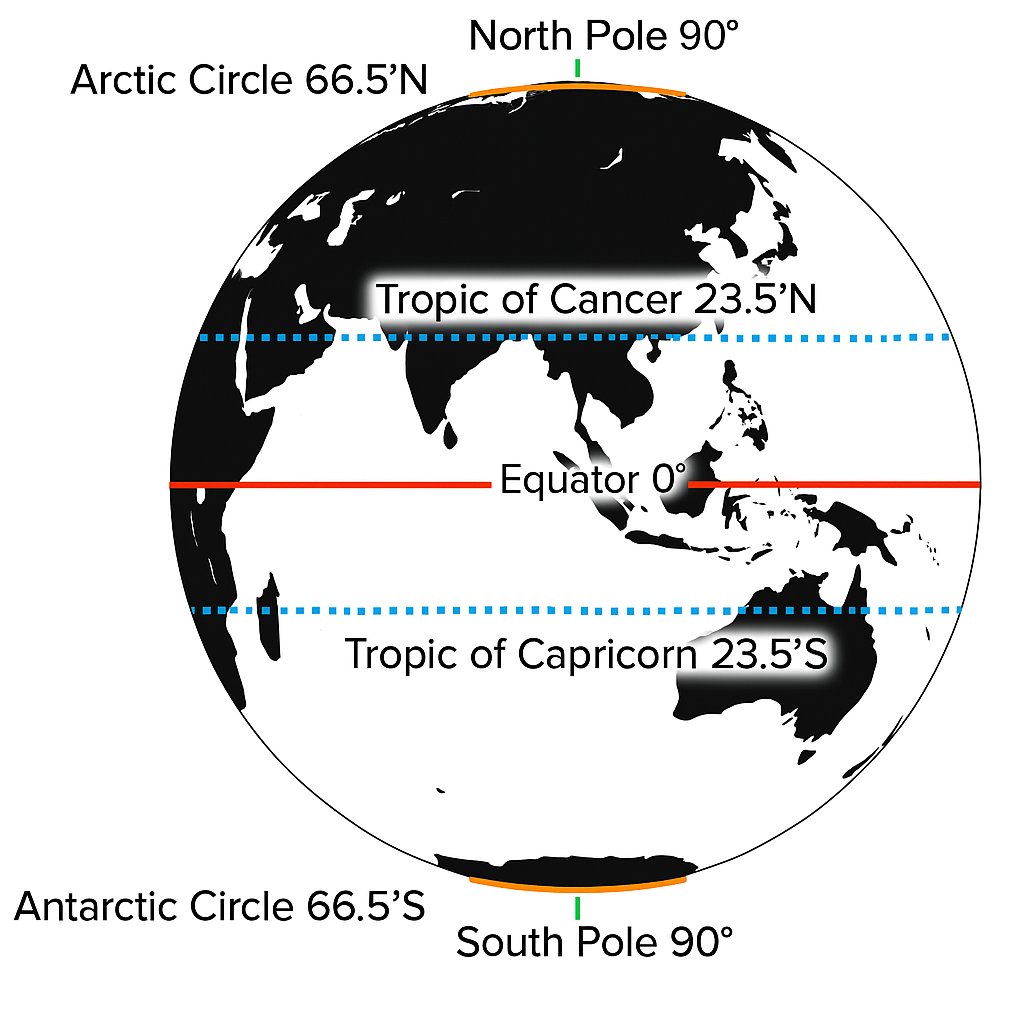
To truly understand why the tropics are hot while regions near the poles are cold, we first need to explore how Earth’s temperature fluctuates in the first place. How energy from the Sun interacts with our planet, and how that varies depending on where you are on the globe.
Understanding the Earth-Sun Relationship
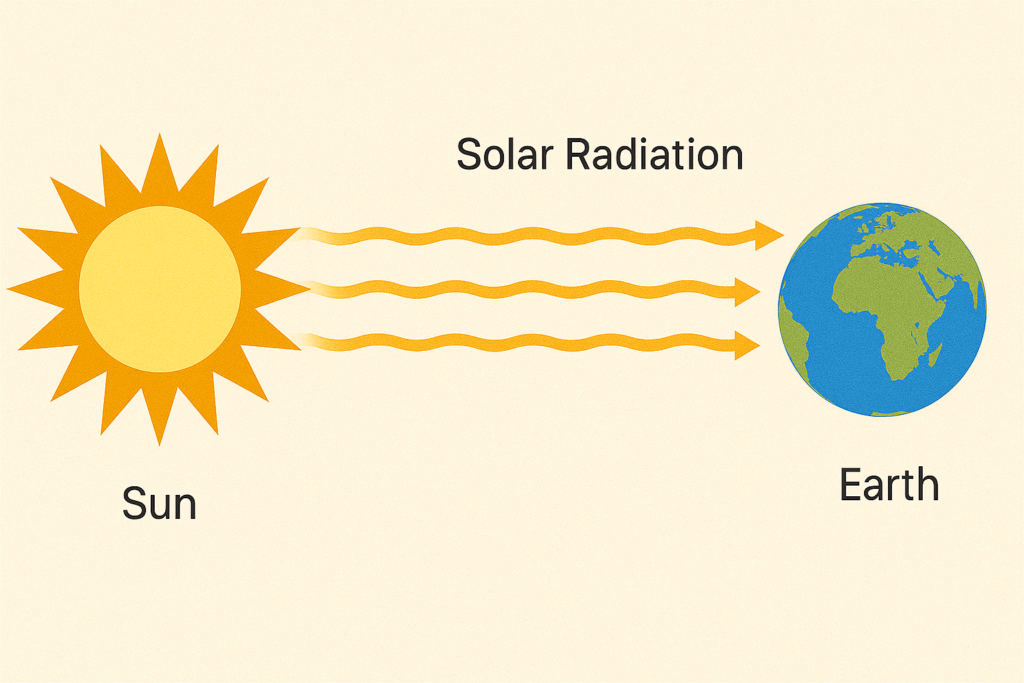
If we think intuitively, most of us already know that the Sun plays a huge role in determining how hot or cold it is. A simple example? Compare daytime and nighttime temperatures under a clear sky. It’s hotter during the day, no surprise there because the Sun is up and sending its energy directly to Earth.
But here’s the interesting part: the Earth is a sphere, and that changes everything.
When sunlight hits the Earth, it doesn’t hit every place with the same intensity. The equator receives sunlight at a near-perpendicular angle, basically 90 degrees, meaning the energy is concentrated over a smaller area. As you move toward the poles, the angle becomes more slanted, and the same amount of solar energy gets spread out over a larger surface area. Less intensity, less heat.
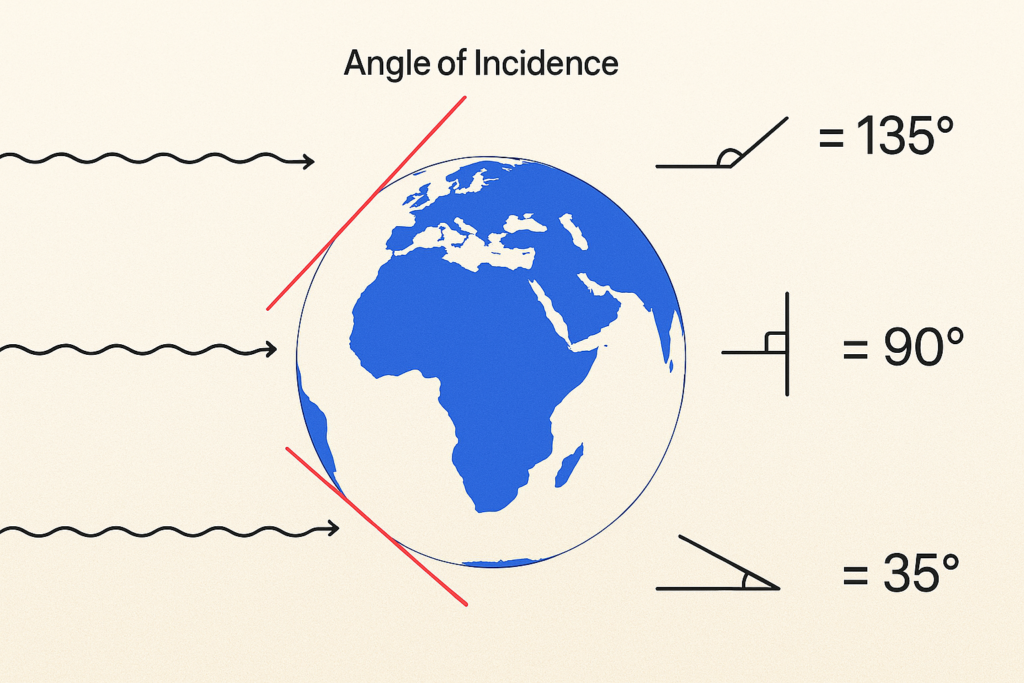
This is why the Sun heats equatorial regions much more effectively than the polar regions. Countries near the equator end up with tropical weather, hot, humid, and with only two main seasons: sunny and rainy.
But that raises an important question. Why does a different incident angle lead to different heat intensity?
The answer lies in geometry. The total solar energy hitting the Earth doesn’t change, but when the angle of sunlight is more oblique, that energy is distributed over a wider area. It’s not that the energy is lost. It’s just spread out. The amount of energy per square meter becomes lower the farther you move from the equator. So, the reduced heat isn’t due to energy disappearing, but rather to how it’s geometrically distributed across the curved surface of the Earth.
This simple but powerful concept helps explain why regions near the equator, such as Malaysia, are hot and wet. The intense, direct heating fuels rapid evaporation and cloud formation, making these areas prone to heavy rainfall. On the other hand, areas near the poles receive sunlight at much shallower angles, resulting in cooler climates with far less evaporation and precipitation.
Let’s Talk Numbers: Intensity on different latitude
We can even capture this effect with a simple formula. Imagine the Sun’s radiation has a peak intensity of Io when it arrives perpendicular to the surface. At any given latitude θ , the actual intensity I is reduced by the angle at which the rays strike. Mathematically, this is
I = I₀ . cos(θ)
- What is θ? It’s the angle between the Sun’s rays and the vertical at that location — on a spherical Earth, that angle is essentially the latitude.
- Why cosine? When θ = 0° (the equator at noon), cos(0°) = 1, so I = I₀. The Sun is directly overhead, and the full intensity arrives.
- Moving toward the poles: As θ increases, cos(θ) decreases, so I gets smaller. By the time you reach the poles (θ ≈ 90°), cos(90°) = 0, and very little direct solar energy arrives.
To Sum It All Up
So, why doesn’t snowfall reach the tropics?
It’s not just about the weather. It’s about geometry, physics, and how our planet is shaped. The Earth’s spherical form means sunlight doesn’t hit every part of the surface equally. Near the equator, the Sun’s rays are direct and concentrated, delivering more energy per square meter. Farther from the equator, the same energy is spread out over a wider area, leading to cooler temperatures.
This simple yet powerful idea explains a lot: why Malaysia is hot and humid, why snow never falls there, and why our planet has such diverse climate zones. From icy polar caps to lush tropical rainforests.
What began as a childhood question rooted in curiosity, “Why doesn’t it snow here?”, turns out to be an entry point into the fascinating science of Earth’s climate system. And sometimes, it’s those small, innocent questions that open the door to big, beautiful understandings about the world we live in.
Coming Up Next: What About the Four Seasons?
So we now understand why countries near the equator, like Malaysia, are warm year-round. But what about countries that experience winter, spring, summer, and autumn? What causes the seasons? Why do some places snow while others never will?
In my next post, I’ll explore how the Earth’s tilt and orbit around the Sun give rise to the four seasons, and why snow is (unfortunately?) not in Malaysia’s forecast anytime soon.